
Common Room combines buyer signals, enrichment and AI-assisted research to help revenue teams prioritize accounts and people. Its usefulness depends on identity matching and signal interpretation, with contact capacity, credits and integrations shaping the commercial choice.
Documentation-based assessment · How we reviewed it
Useful when signals can lead to a defined next action
Shortlist Common Room when the problem is deciding who merits attention and why. It is less useful if the team collects signals without an agreed response. Validate matches and the context behind a priority before turning it into outreach.
- Best fit
- Revenue teams with multiple buyer-signal sources and a defined response process
- Review scope
- Buyer intelligence, signal context and prospect research
- Main watch-out
- Identity matches and intent signals are indicators, not proof of purchase intent.
In this review
Who should consider Common Room?
A revenue operations or demand-generation team with CRM and engagement data can evaluate a signal-led process. Start with one segment and an explicit action for qualified signals. Compare Clay for configurable enrichment, Apollo for data and execution, and 6sense or Demandbase for broader account-based programs. The right choice depends on the quality of your existing sources and the team responsible for acting on them.
Why shortlist it
- Connects signals with buyer and account context.
- Supports segmentation and repeatable response workflows.
- Public plans describe capacity and research-credit considerations.
What to watch
- Matching errors can combine the wrong person or account.
- More signals can create noise without an action process.
- Contact limits, credits and add-ons affect the complete cost.
Features that matter in daily work
The current offering includes Person360, enrichment, RoomieAI and scoring alongside integrations. Assess entity matching, useful research and execution readiness as separate stages. Official product details ↗
1. Person and account context
Common Room combines identity and signal information. Audit similarly named people, shared domains and multiple roles before trusting an aggregated profile. Source ↗
2. RoomieAI research
Research credits support additional account and person context. Check whether a finding is current and sufficiently specific to justify a business action. Source ↗
3. Segments and workflows
Alerts and workflows can route attention to a seller or marketer. Design an action and an exception queue rather than creating more notifications. Source ↗
A closer look at Common Room
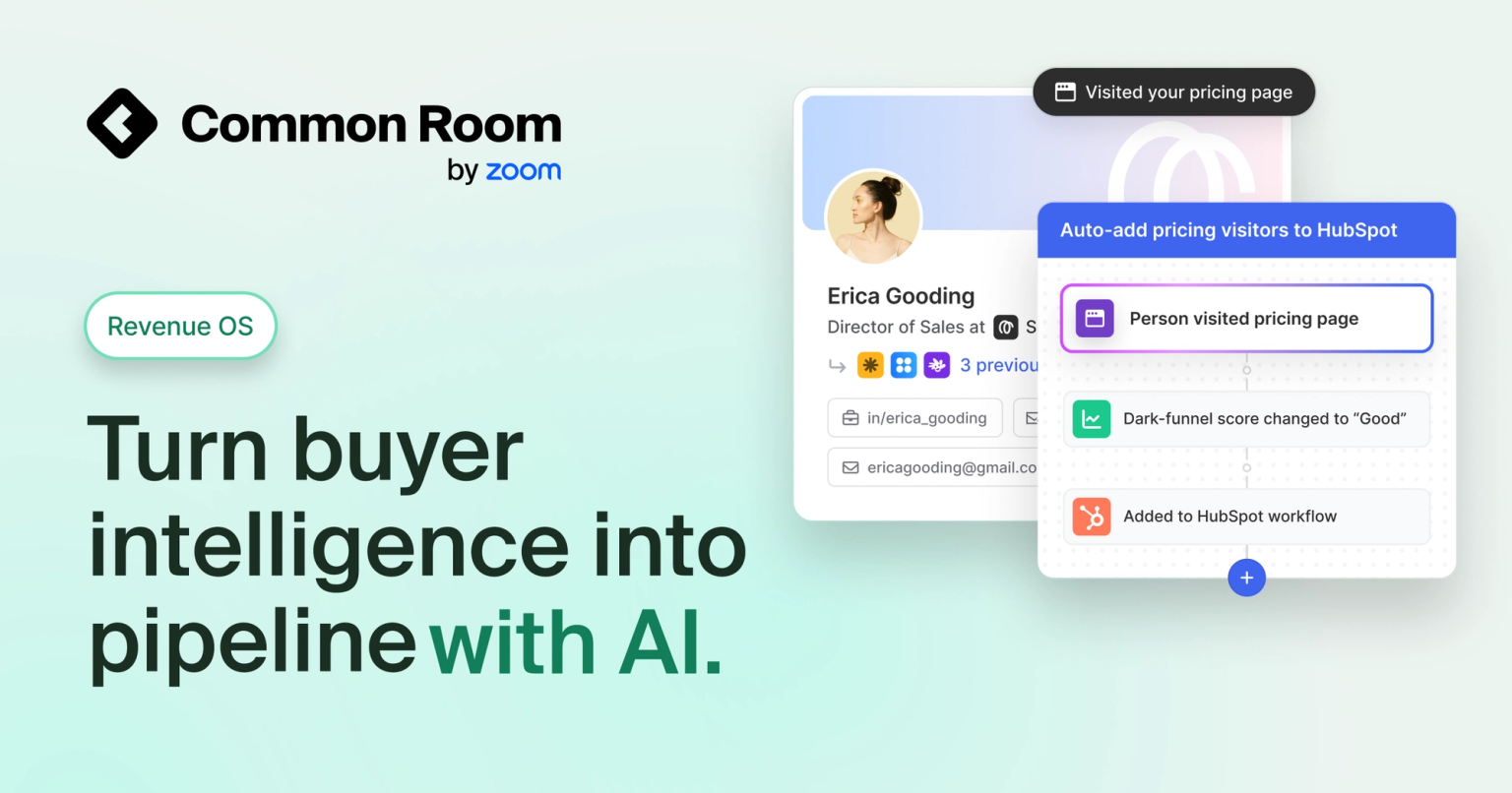
The provider preview above introduces the product. The diagram below is our suggested evaluation flow, not a product interface or measured result.
Original AI Tools Hotlist workflow illustration; not a product interface or test result.
Practical workflows to evaluate
These are suggested evaluations, not tests we performed. Use material you own or have permission to share.
Audit identity resolution
Use known test contacts with name collisions, job changes and multiple company associations.
Evaluate: Check incorrect merges, stale roles and the ability to inspect or correct the source context.
Evaluate an actionable signal
Choose one approved signal and a small target segment, then review every alert manually.
Evaluate: Measure relevant alerts, false positives and whether a seller has a clear next step.
Plans, allowances and value
The checked page lists Essential, Advanced and Enterprise, with differences in seats, contacts, research and prospecting capacity. Some data, export and signal capabilities are add-ons. Request the exact integrations and volumes needed, rather than assuming all connectors and exports are included.
| Option | What to check | Decision rule |
|---|---|---|
| Essential | Contact capacity, included seats and research credits | Pilot a narrowly defined signal-led workflow. |
| Advanced / Enterprise | More capacity, integrations and support | Match the plan to the actual connected data and team size. |
| Add-ons | Product signals, exports and other data capabilities | Include only components necessary for the intended action. |
Check official plan details ↗ Confirm your billing interval, currency, applicable tax, renewal terms and feature availability before subscribing. Promotional prices can differ from renewal prices.
Limits, privacy and responsible use
A signal may describe interest or activity without identifying an active buyer. Account and person matching can also be wrong or stale. Check your own known records and keep an uncertainty state. Avoid interpreting a generated account narrative as independently verified intent.
Review the permitted use of product, community, web and third-party data. Decide which identities may be combined, who can export them and how corrections or deletion requests propagate across connected systems.
Documentation establishes advertised capabilities, not accuracy on your task. We have not measured speed, reliability, time savings or business outcomes. Keep an accountable person responsible for approval.
Alternatives worth comparing
Compare the job you need done rather than assuming every AI tool is a direct replacement. These are workflow alternatives, not a performance ranking.
A revenue operations or demand-generation team with CRM and engagement data can evaluate a signal-led process. Start with one segment and an explicit action for qualified signals. Compare Clay for configurable enrichment, Apollo for data and execution, and 6sense or Demandbase for broader account-based programs. The right choice depends on the quality of your existing sources and the team responsible for acting on them.
Common questions
Does a signal prove someone wants to buy?
No. Treat it as context for investigation rather than permission or a guaranteed opportunity.
What should we pilot?
One signal source, one segment and one clearly owned response process.
Is every integration included?
The current plan matrix distinguishes capacity, integrations and add-ons; confirm your exact setup.
Have you tested and rated this tool?
This is a research-based assessment of official documentation. We have not recorded hands-on tests or assigned a numerical score. The recommendations explain suitability and trade-offs.
Sources and review method
We reviewed official product and plan information on 14 October 2026. Suitability judgments and suggested trials are our editorial assessment. Media is credited to its provider and does not establish hands-on testing. Features, prices and rollouts can change.
No affiliate tracking has been added to these links. Editorial responsibility: AI Tools Hotlist editorial desk. Editorial standards · Suggest a correction · More reviews.